Cooling costs
Evaporative Cooler vs Air Conditioner: Running Costs and Operating Conditions
An electricity-cost example compares evaporative cooling with a split air conditioner, with humidity, ventilation and maintenance considered alongside the figures.
Where the cost difference comes from
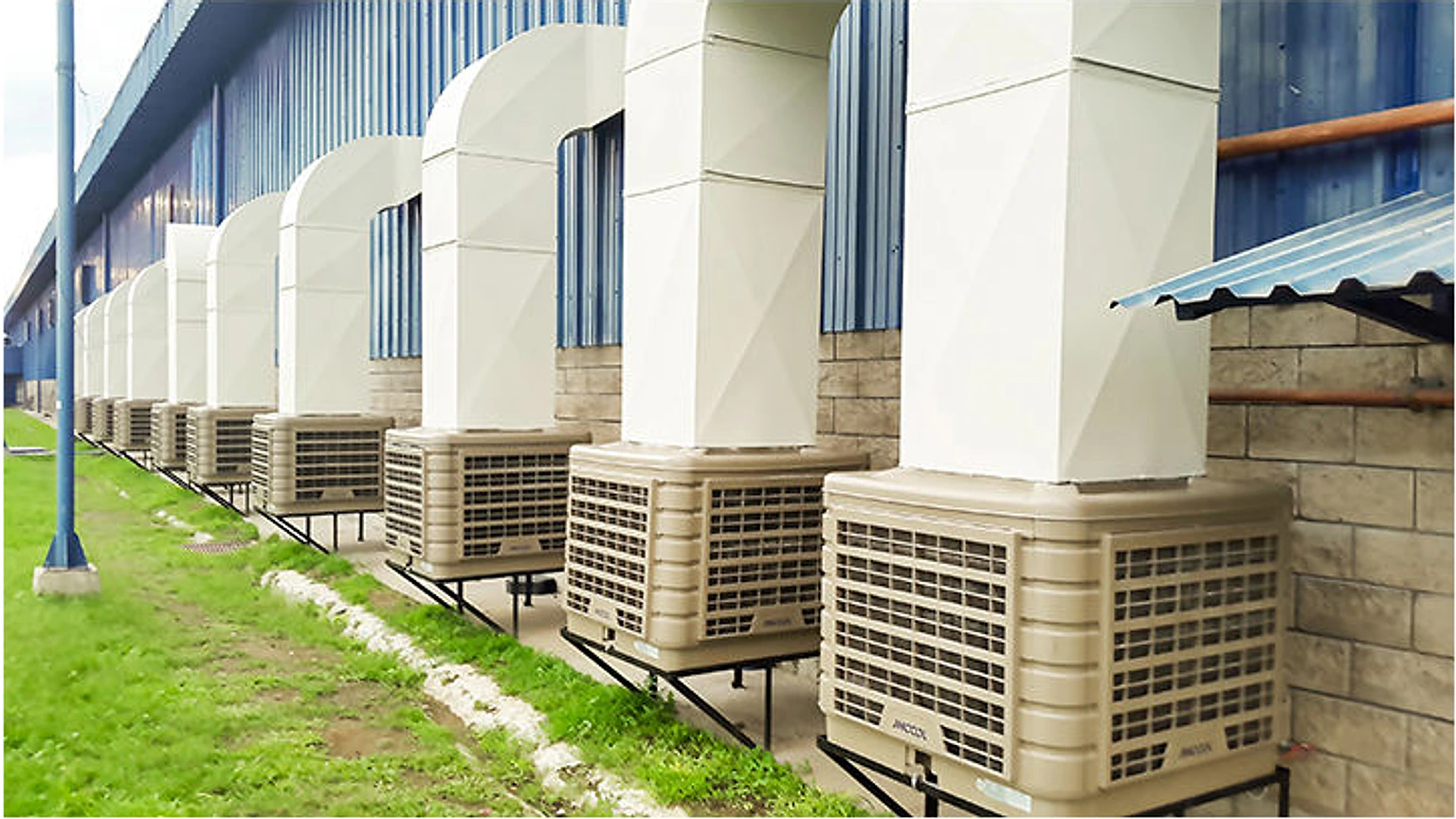
An evaporative cooler uses water evaporation to absorb heat, with electricity mainly powering the fan and pump. A compressor air conditioner uses a refrigerant circuit. The two systems have different energy demands and operating requirements.
For a 380 W cooler and a 1,500 W split air conditioner, equal operating hours give electricity consumption of roughly 25% for the cooler. This is a comparison of power consumption; it does not establish equivalent cooling performance in every setting.
Evaporative cooling generally suits hot, dry environments with adequate ventilation. Dry weather in Madrid, Phoenix, Tehran and inland Australia can support its use. Humid locations such as Singapore, Lagos and Miami require particular attention to local humidity.
Calculating electricity costs
The example assumes 8 hours of operation a day, 30 days a month and an electricity tariff of €0.18/kWh, with both units running continuously at the stated power.
| Scenario | Evaporative cooler (380 W) | Split A/C (1,500 W) |
|---|---|---|
| Monthly electricity use | 91.2 kWh | 360 kWh |
| Monthly electricity cost | €16.42 | €64.80 |
| Annual cost, 6 months of use | €98.50 | €388.80 |
| Electricity cost over 5 years | €492.48 | €1,944 |
In this example, the cooler's electricity cost is about one quarter of the air conditioner's, with a five-year difference of approximately €1,450. Purchase, installation, water, cleaning and repair costs are excluded. Actual bills also depend on operating load and local tariffs.
Lower electricity consumption does not establish equal cooling capacity. Both options should first be assessed against the site's temperature, humidity and ventilation requirements.

Assessing cooling performance separately
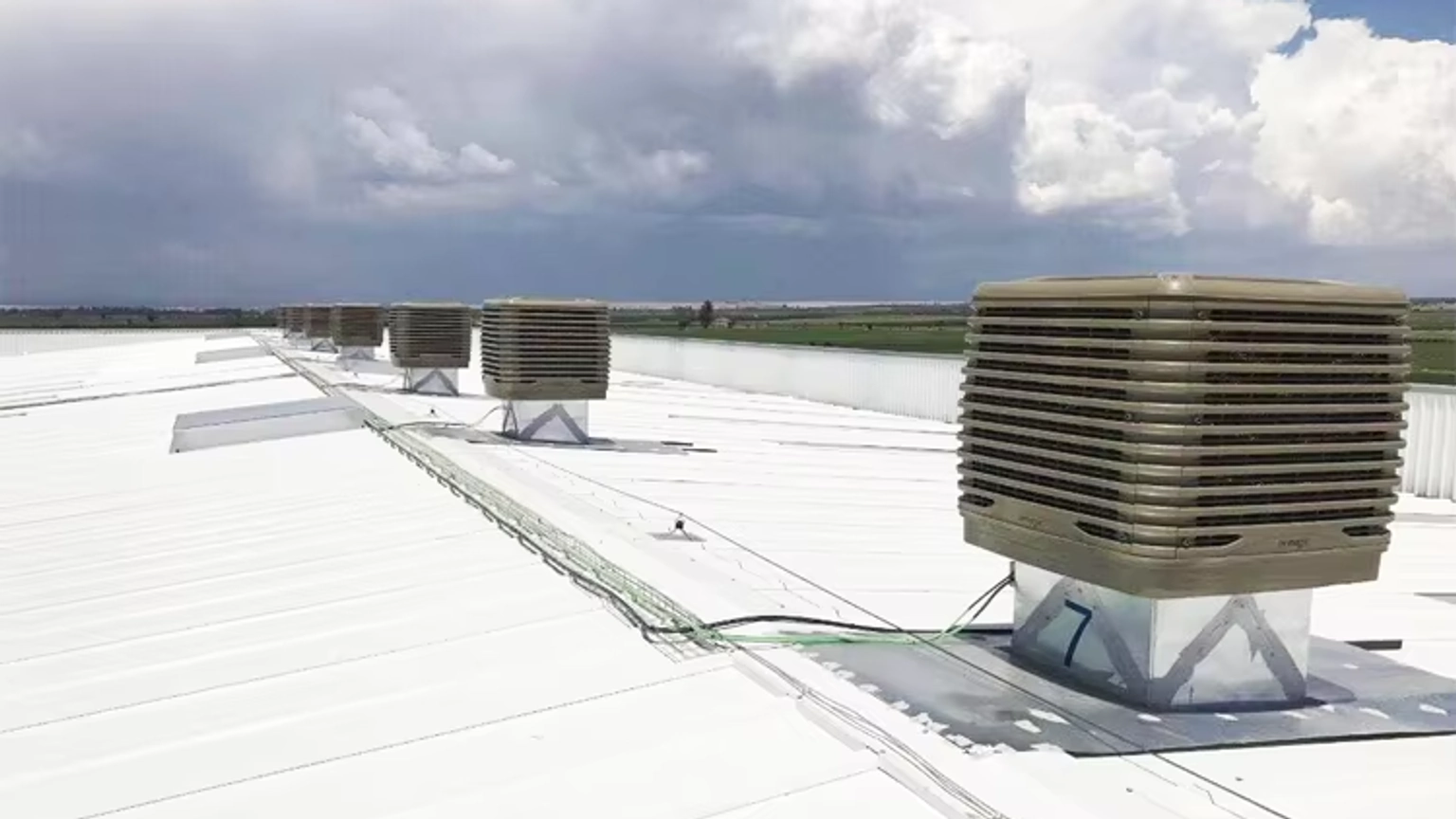
Airflow, supply-air temperature reduction and coverage depend on the model and incoming air conditions. The JHCOOL 30 Series industrial models described here offer airflow of up to 30,000 m³/h and a supply-air temperature reduction of 8–15°C. Applications in 200–400 m² open warehouses, workshops or vehicle repair areas still require assessment of ceiling height, heat load and ventilation.
The domestic JH802 is listed at 3,000 m³/h and 110 W, for 25–40 m², with a typical supply-air temperature reduction of 6–10°C and a single-phase 220 V supply. It is portable and requires no outdoor condenser. These temperature reductions refer to supply air, not the whole room; the JH802 also differs from the 380 W unit used in the cost example.
Three conditions to check before purchasing
- Summer humidity. Above roughly 65% relative humidity, the potential for evaporative cooling generally decreases. Measure local temperature and humidity and, where needed, use a psychrometric chart.
- Temperature control. The theoretical cooling limit is the incoming air's wet-bulb temperature; actual supply air is usually warmer. Enclosed sites requiring temperatures consistently below 18°C, including server rooms targeting 16°C, need assessment of compressor cooling or other controlled systems.
- Water quality. Hard-water minerals can build up as scale on cooling pads. Water treatment and cleaning intervals should follow local water quality and equipment requirements, including softened or reverse-osmosis water where appropriate.
Common applications
Across the more than 100 countries supplied by Jinghui, common applications include:
- Industrial and commercial premises in arid and semi-arid regions: factories, warehouses, workshops, agricultural processing facilities, vehicle repair shops and logistics centres.
- Outdoor and partly enclosed hospitality spaces: restaurant patios, beer gardens, resort terraces and open-air markets.
- Homes in areas with dry summers: inland Spain, central Italy, the Hungarian and Romanian plains, northern Mexico, the US Mountain West, inland Turkey, northern Iran, the South African highveld and inland Australia. Suitability still depends on seasonal humidity.
For open spaces without existing cooling, evaporative units can provide airflow and cooling together. Purchase cost, maintenance and ventilation arrangements should also be compared with air conditioning.
Choosing for the site
In a suitable climate with adequate ventilation, evaporative cooling can reduce electricity costs. A complete comparison includes water, maintenance and installation, and checks whether the equipment can deliver the required comfort.
For model and quantity advice, Jinghui can assess the site's dimensions, ceiling height and location.