Cooling principles
How Evaporative Coolers Work: Four Steps in the Cooling Process
An explanation of airflow, water evaporation, supply air and water management, with the roles of humidity, ventilation and operating conditions.
Four steps in evaporative cooling
Evaporative coolers use water evaporation to absorb heat from air. Household and industrial units differ in airflow and power, but share the same basic process.
- Air passes through wet pads. A pump distributes water over cellulose or polymer pads while a fan moves warm air through their wetted surfaces.
- Water evaporates and absorbs heat. Some water enters the air as vapour, lowering its temperature and increasing its moisture content. Heat absorption depends on the amount evaporated and the operating conditions.
- Cooled air enters the occupied area. Systems drawing outdoor air need an outlet for warm indoor air. The air-change rate depends on actual airflow and room volume, not floor area alone.
- Water is replenished and drained. Unevaporated water returns to the reservoir. As evaporation continues, minerals become more concentrated; makeup water and drainage help control the concentration. Arrangements vary by model. The industrial example gives water use of 9–11 L/h in hot, dry conditions; actual use requires assessment of the unit and site.
The process does not rely on a compressor refrigerant circuit. Water absorbs heat through evaporation, while the fan and pump maintain airflow and water circulation.
Why humidity affects supply-air temperature
The theoretical limit for direct evaporative cooling is the wet-bulb temperature of the incoming air. Actual outlet temperatures are usually higher, depending on pad efficiency, airflow and inlet conditions.
| Example inlet conditions | Approx. wet-bulb temperature | Approx. outlet temperature |
|---|---|---|
| 40°C, 15% relative humidity | 19°C | 21°C |
| 35°C, 30% relative humidity | 22°C | 24°C |
| 30°C, 50% relative humidity | 22°C | 24°C |
| 28°C, 80% relative humidity | 26°C | 27°C |
These figures illustrate the effect of humidity; they are not performance guarantees for a city or model. As air approaches saturation, the potential temperature reduction generally falls. Supply-air temperature is also different from the temperature throughout a room.

Comparing electricity consumption
A 380 W cooler uses roughly one quarter of the electricity of a 1,500 W split air conditioner over equal operating hours. This compares electrical power only; it does not establish equal airflow, cooling capacity or room-temperature reduction.
At 8 hours a day, 30 days a month, 6 months a year and €0.18/kWh, annual electricity costs are approximately €98.50 and €388.80, respectively. A complete operating-cost estimate also considers load, water and maintenance.
Considerations for project and procurement teams
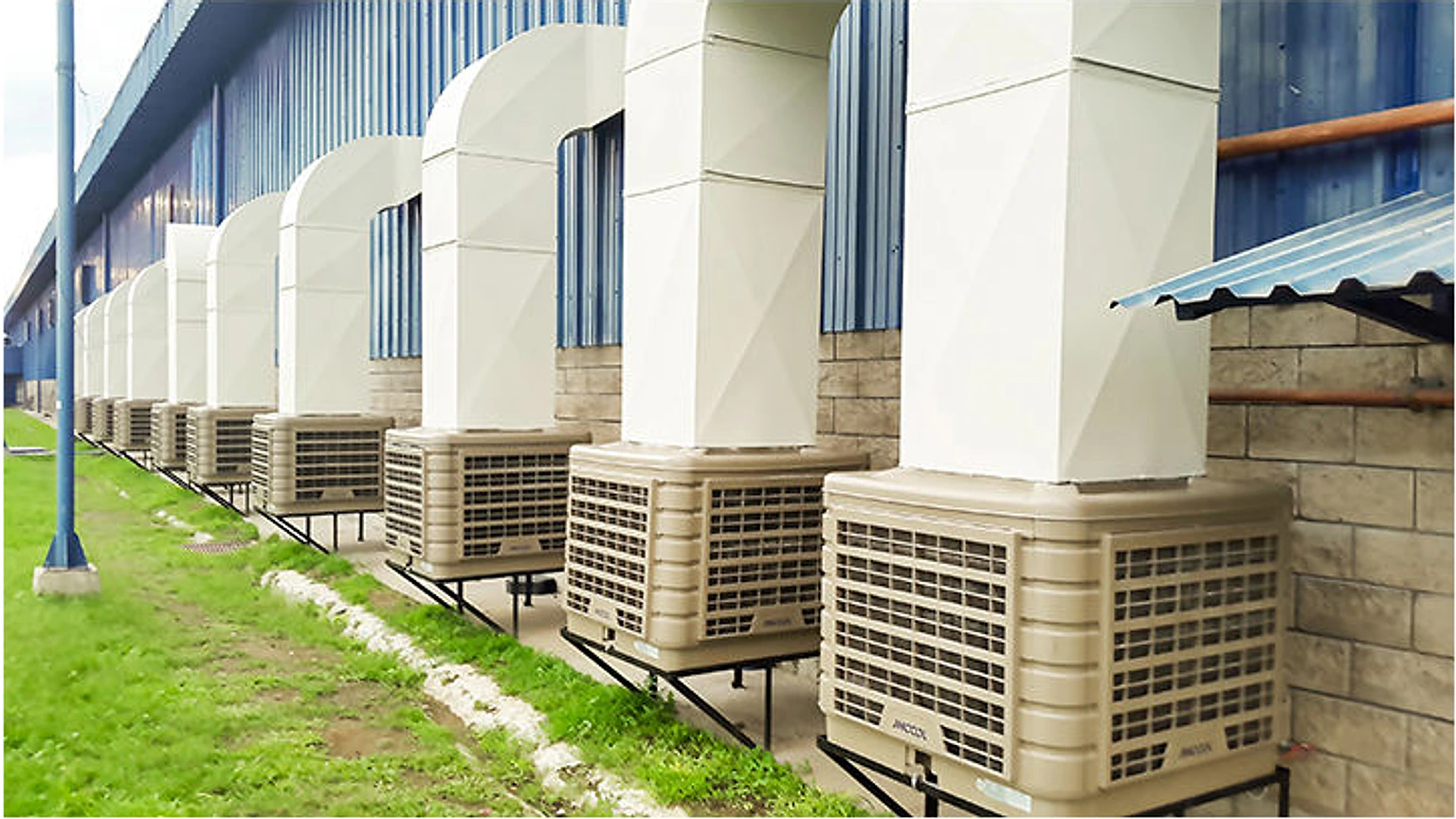
- Purchase and installation. Evaporative systems need no refrigerant pipework or outdoor condenser, but industrial installations may still require ducts, water supply, drainage and electrical work. Compare complete project costs.
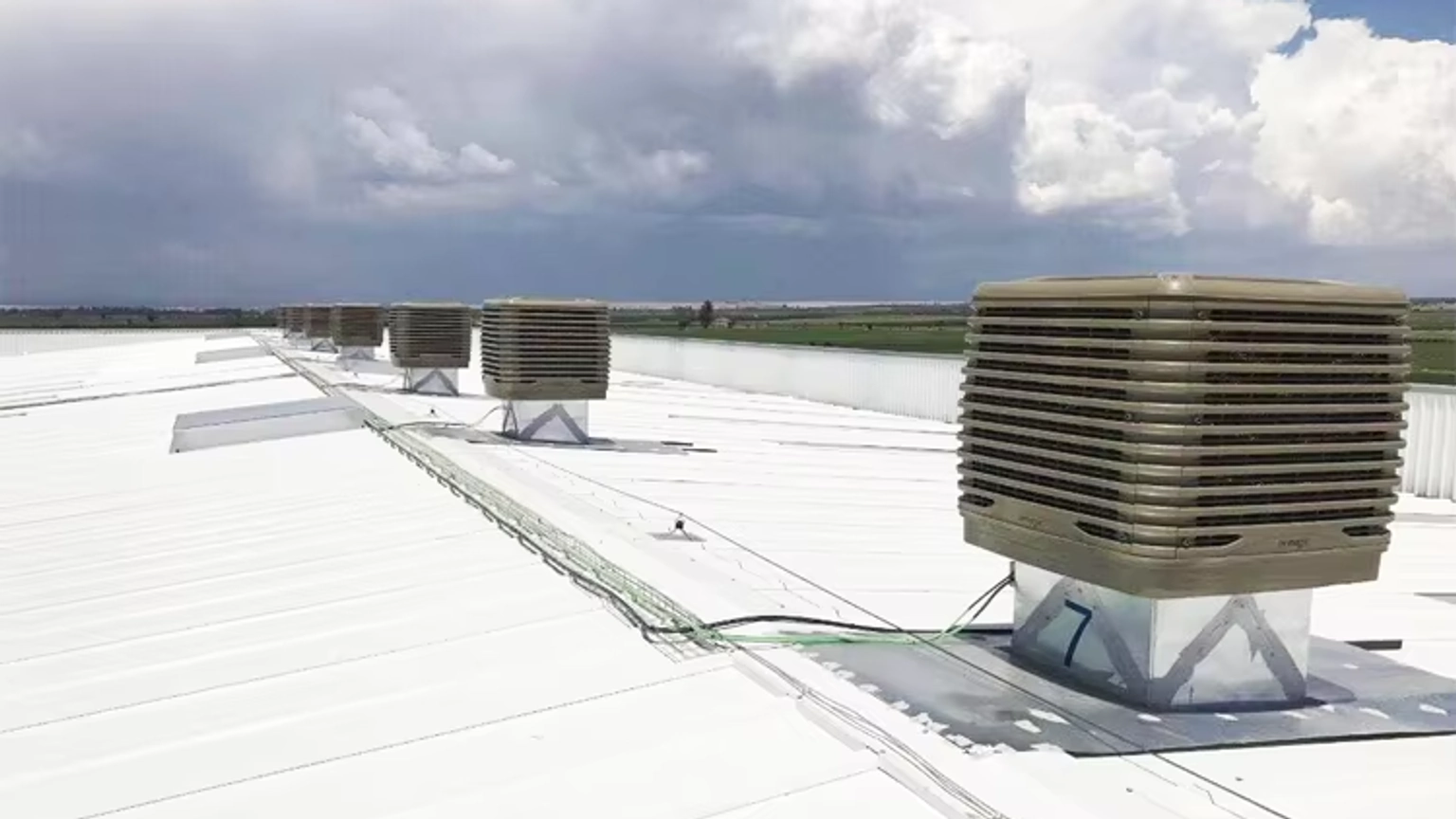
- Fresh air and exhaust. Outdoor-air units can provide ventilation alongside cooling. Supply and exhaust must be matched, and outdoor air quality assessed.
- Routine maintenance. Pads, reservoirs, pumps and fans require inspection, cleaning or replacement. Intervals and personnel requirements should follow the equipment manual and site conditions.
- Refrigerant management. Direct evaporative cooling does not use a compressor refrigerant circuit and needs no leak checks for that circuit. Other installation, hygiene and electrical requirements still apply to the project.
When other systems are needed
High humidity limits direct evaporative cooling, and enclosed spaces require particular attention to exhaust arrangements. Server rooms, pharmaceutical storage and precision manufacturing with strict temperature and humidity requirements should not rely solely on direct evaporative cooling to maintain their environment.
For sites requiring temperatures consistently below 18°C, compressor cooling or combined systems should be assessed against local weather, heat load and operating requirements. Equipment selection depends on the site, rather than a single wet-bulb threshold.
Jinghui can assess options using the site's location, dimensions, target temperature and ventilation arrangements.